


Anna Köhler, Amena L. T. Khan, Joanne S. Wilson, Carsten Dosche, Mohammed K. Al-Suti et al.
J. Chem. Phys. 136 (2012) 094905
The intrinsic non-radiative decay (internal conversion) from the triplet excited state in phosphorescent
dyes can be described by a multi-phonon emission process. Since non-radiative decay of triplet
excitons can be a significant process in organic light-emitting diodes, a detailed understanding of
this decay mechanism is important if the overall device efficiency is to be controlled. We compare
a deuterated Pt(II)-containing phenylene ethynylene with its non-deuterated counterpart in order to
investigate which phonon modes control to the non-radiative decay path.We observe that deuteration
does not decrease the non-radiative decay rate. A Franck-Condon analysis of the phosphorescence
spectra shows that the electronic excitation is coupled strongly to the breathing mode of the phenyl
ring and the C≡C carbon stretching modes, while high-energy C-H or C-D stretching modes play
an insignificant role. We, therefore, associate the internal conversion process with the carbon-carbon
stretching vibrations.
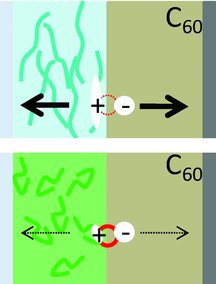 Internal photocurrent quantum yields near 100% can be obtained from the separation of loosely bound geminate pairs when sufficiently large electric fields are applied to organic heterojunctions. The fields needed for complete electron–hole dissociation decrease to those prevailing in organic solar cells under operating conditions when well-conjugated polymers are employed.
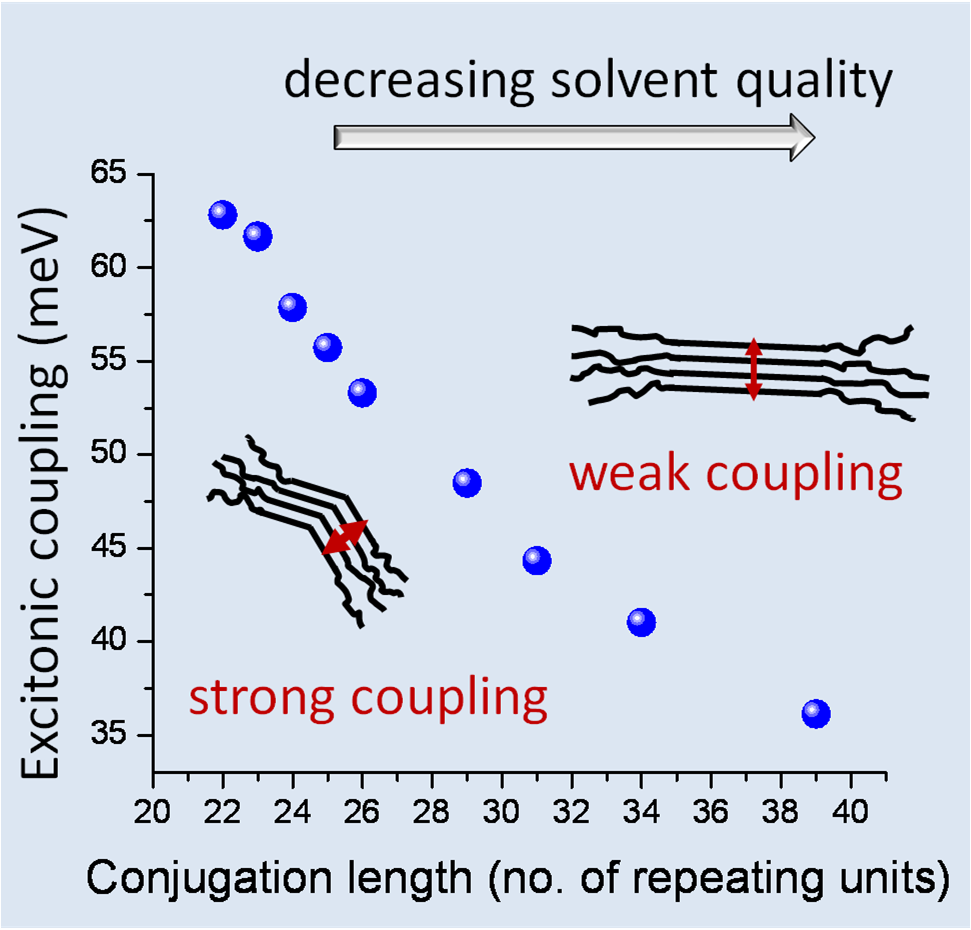 Aggregate formation in poly(3-hexylthiophene) depends on molecular weight, solvent, and synthetic method. The interplay of these parameters thus largely controls device performance. In order to obtain a quantitative understanding on how these factors control the resulting electronic properties of P3HT, we measured absorption in solution and in thin films as well as the resulting field effect mobility in transistors. By a detailed analysis of the absorption spectra, we deduce the fraction of aggregates formed, the excitonic coupling within the aggregates, and the conjugation length within the aggregates, all as a function of solvent quality for molecular weights from 5 to 19 kDa. From this, we infer in which structure the aggregated chains pack. Although the 5 kDa samples form straight chains, the 11 and 19 kDa chains are kinked or folded, with conjugation lengths that increase as the solvent quality reduces. There is a maximum fraction of aggregated chains (about 55 ± 5%) that can be obtained, even for poor solvent quality. We show that inducing aggregation in solution leads to control of aggregate properties in thin films. As expected, the field-effect mobility correlates with the propensity to aggregation. Correspondingly, we find that a well-defined synthetic approach, tailored to give a narrow molecular weight distribution, is needed to obtain high field effect mobilities of up to 0.01 cm2/Vs for low molecular weight samples (=11 kDa), while the influence of synthetic method is negligible for samples of higher molecular weight, if low molecular weight fractions are removed by extraction.
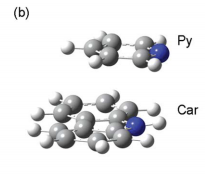 Although carbazole-containing copolymers are frequently used as hole-transporting host materials for polymer organic light-emitting diodes (OLEDs), they often suffer from the formation of undesired exciplexes when the OLED is operated. The reason why exciplexes sometimes form for electrical excitation, yet not for optical excitation is not well understood. Here, we use luminescence measurements and quantum chemical calculations to investigate the mechanism of such exciplex formation for electrical excitation (electroplex formation) in a carbazole–pyridine copolymer. Our results suggest that the exciplex is formed via a positively charged interchain precursor complex. This complex is stabilized by interactions that involve the nitrogen lone pairs on both chain segments.
 Lichtenergie in elektrischen Strom zu verwandeln ist die Funktion von Solarzellen, die