Lehrstuhl EP2 Uni Bayreuth

Our research is concerned with the optical and electronic processes that take place in organic semiconductors. In contrast to most inorganic semiconductors, organic materials can be processed easily, either by thermal evaporation or by from solution. This opens up new, highly promising manufacturing routes for the low-cost production of opto-electronic devices such as light-emitting displays (LEDs), solar cells and transistors.

In order to advance organic devices it is imperative to understand very clearly how excited states or charges are generated, and what determines their energy and extent, how they migrate through the semiconductor, and how they decay.

When addressing these issues we focus in particular on the relationship between electronic, chemical and morphological structure. We therefore use a range of time-resolved spectroscopic techniques in combination with electrical and structural studies.

Prof. Dr. Anna Köhler

The research group is lead by Professor Anna Köhler

Research News
Impact of Photoluminescence Imaging Methodology on Transport Parameters in Semiconductors
16. Oktober 2026

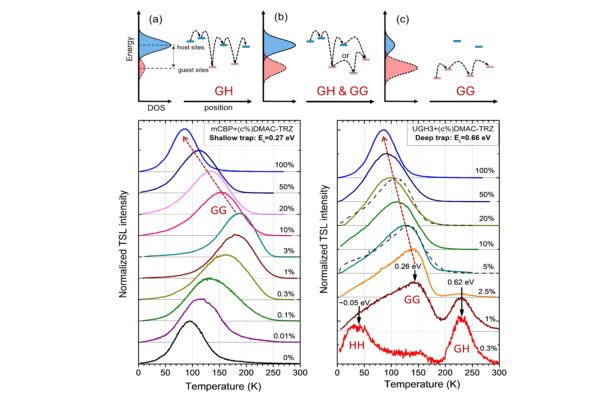
Triplet–triplet annihilation-induced delayed emission provides a pathway for investigating triplets via emission spectroscopy. This bimolecular annihilation depends directly on the transport properties of triplet excitons in disordered organic semiconductors. Photoluminescence (PL) imaging is a direct method for studying exciton and charge-carrier diffusivity. However, most of these studies neglect dispersive transport. Early time scale measurements using this technique can lead to an overestimation of the diffusion coefficient (DT) or diffusion length (Ld). In this study, we investigated the time-dependent triplet DT using PL imaging. We observed an overestimation of Ld in classical delayed PL imaging, often 1 order of magnitude higher than the actual Ld value. We compared various thicknesses of polymeric thin films to study the dispersive nature of triplet excitons. Transient analysis of delayed PL imaging and steady state imaging reveals the importance of considering the time-dependent nature of DT for the triplet excitons in disordered electronic materials.

Giant Electrostriction in Halide Perovskites Revisited With Double-Modulation Interferometry
18. September 2026

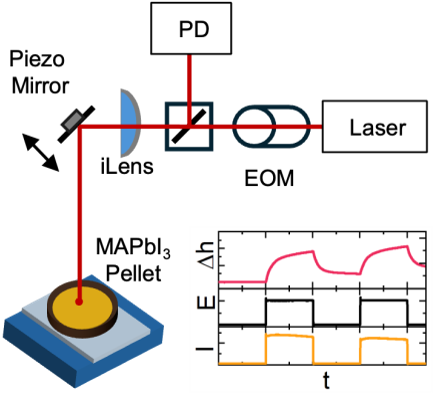
A reported giant electrostrictive effect in halide perovskites has attracted interest for its physical origin and for potential applications in actuation and sensing. However, despite the reported exceptionally large magnitude of the effect, systematic experimental investigation remains limited. In this work, the electromechanical response of methylammonium lead halide perovskites (MAPbX3; X═I, Br, Cl) in the form of powder-pressed pellets, MAPbBr3 single crystals, and MAPbI3 thin films is investigated using a high-resolution double-modulation interferometer. Reference measurements using a commercial electrostrictive polymer confirm that the setup resolves sub-nanometer electromechanical displacements. In contrast to previous reports of giant electrostrictive compression in halide perovskites, no such intrinsic compressive electrostriction is observed in any of the samples. Instead, an expansion at twice the driving frequency is detected. Analysis of the frequency dependence and step response indicates that the expansion arises primarily from thermal expansion caused by Ohmic currents that lead to Joule heating.

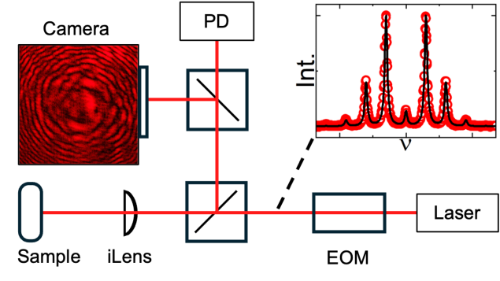
FM and double modulation interferometry with sub-nanometer resolution using the iLens technique
20. Mai 2026

We report a modulation technique applicable to optical two-beam interferometers with unequal arm lengths that allows
for highly precise, low-noise displacement measurements below the nanometer regime with a compact optical layout.
The technique is inspired by frequency modulation (FM) spectroscopy and employs an external electro-optic modulator
with sinusoidally phase modulated laser light in the radio-frequency (RF) regime (MHz frequencies). By combining
the RF modulation with a secondary mechanical modulation at a lower frequency to a super-heterodyne scheme we
achieve continuous sign-resolved tracking of the arm length difference over many wavelengths, and low-frequency
laser noise is effectively suppressed. Our set-up is based on the compact interference lens (iLens) technique and can
measure displacements of samples with a wide variety of surface qualities. We examined the system performance
using two samples, a mirror surface and a commercial aneroid capsule without specular reflectivity. Stable multi-fringe
operation with sub-nanometer resolution is demonstrated; the noise floor reaches 10 pm/√Hz at frequencies above
10 Hz in a regular laboratory environment. This work demonstrates a versatile, simple set-up capable of sign-resolved,
sub-nanometer displacement sensing suitable even for non-ideal surface conditions.

Teaching
Research
Publications